

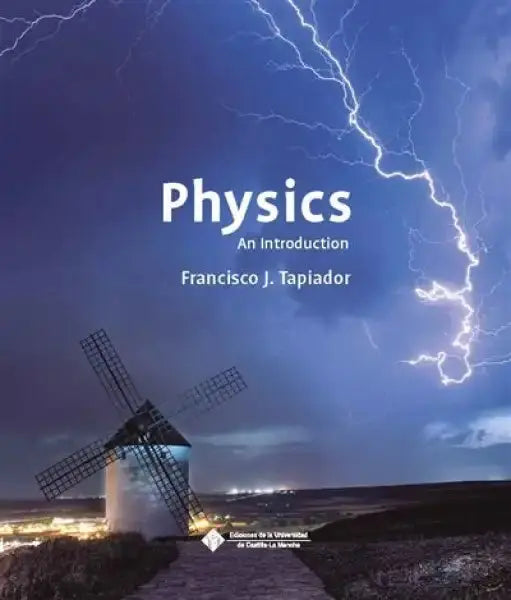
Physics. An Introduction
Physics. An IntroductionCouldn't load pickup availability
Delivery of the book "Physics. An Introduction" :1–3 days within Spain,2–6 days across Europe.
Buy the book "Physics. An Introduction" in Ukrainian in Spain and Portugal.
- Books by BOOKLYA are available at www.booklya.shop.

Download our mobile app
Get the best shopping experience with our mobile app
- description
- FAQ
Physics. An Introduction by Francisco Javier Tapiador Fuentes is a comprehensive and accessible textbook designed for readers seeking to understand the core concepts of physics and how they apply to the natural world. With clear explanations and a multitude of real-world examples, this book navigates the fundamental principles that shape modern scientific understanding.
Beginning with classical mechanics — including motion, forces, and energy — the text leads readers through essential topics such as the behavior of fluids, the nature of light and electromagnetic radiation, and the basic structure of matter. The narrative bridges classical physics with key aspects of twentieth-century science, introducing readers to quantum physics and relativity in a manner that remains engaging without oversimplifying.
Throughout its 392 pages, Physics. An Introduction emphasizes context and application, helping readers grasp not just theoretical constructs but also their relevance to contemporary challenges. Topics such as renewable energy, climate science, and the role of experimental methods in advancing human knowledge are woven into the discussion, making the book useful for both academic coursework and self-guided study. The author’s experience teaching physics over two decades at the Universidad de Castilla-La Mancha is reflected in the book’s structured yet approachable style. The minimal reliance on complex mathematics broadens accessibility, making it suitable for students in environmental sciences, biology, architecture, geology, or related fields who require a semester-long introductory text.
Whether you are a university student tackling your first physics course or a lifelong learner curious about how the universe operates, this book offers a solid foundation in both classical and modern physics concepts. Its balanced treatment of theory and practical examples ensures that readers develop a meaningful understanding of physical laws and their everyday significance.